Branding: How to Build a Recognizable Brand
Explore our practical guide to building a strong B2B brand that people trust, remember, and choose. Learn core visual branding strategies from our agency.
Branding
September 10, 2026

You see a logo, hear a jingle, or read a tagline, and you instantly know the company behind it. That reaction isn't luck. It's the result of deliberate work.
Branding is the process of shaping how people recognize and feel about your business, and it includes your name, logo, colors, voice, values, and the experience customers have with you. A brand identity is what you build and put out into the world. Brand perception is what your audience actually thinks and feels in return. The gap between those two things is where most branding work happens.
This guide walks through what branding looks like in daily practice, how it supports growth, and the steps to build a brand that holds up over time. You'll learn how to set a strategic foundation, design an identity people remember, keep things consistent everywhere customers find you, and track whether any of it is working.
Branding is a set of decisions you make and actions you take, while a brand is the result that lives in your customer's mind. Marketing promotes what you sell, branding shapes how people feel about you, and every interaction a customer has adjusts that feeling.
Your brand is what people think and feel when your company comes up. It is your reputation, and you do not fully control it.
Branding is the work you do to influence that reputation. It includes naming, logo design, color choices, typography, messaging, and tone of voice.
Think of it this way:

The American Marketing Association defines a brand as a name, term, design, or symbol that identifies goods or services and sets them apart. Branding is how you build and manage those signals over time.
Marketing pushes for action right now. Branding builds the reason someone acts in the first place.
A paid ad, an email campaign, or a discount code is marketing. It has a start date, an end date, and a number attached to it.
Branding does not run on that schedule. It defines your mission, your positioning, and the way you sound in every message.
Here is a simple split:
When your branding is clear, your marketing gets easier. Copywriters know the tone. Designers know the palette. Customers recognize you before they read the headline.
You can design a logo, but you cannot design brand perception. Customers form that on their own, based on what actually happens when they deal with you.
Shipping speed, return policies, support response times, and product quality all feed into brand image. So does what people read in reviews and hear from friends.
This is why customer experience is a branding tool, not a separate department. Zappos built much of its reputation on service, not advertising.
A gap between what you promise and what you deliver damages trust quickly. Consistency across every touchpoint is what closes that gap and keeps perception aligned with your intended identity.
A strong brand helps people notice you, remember you, and pick you over the other options on the shelf. It also builds the kind of trust and connection that keeps customers coming back and adds real financial value to your company.
Brand awareness is the starting point. If buyers don't know you exist, they can't choose you.
Brand recognition takes it further. When someone sees your logo, colors, or packaging and instantly knows who you are, you've cut the mental work out of their decision. Think of Coca-Cola's red script or Nike's swoosh — no name needed.
Recognition alone doesn't close the sale, though. Brand trust does.
Trust is earned through consistent product quality and reliable customer service. Amazon built much of its reputation on fast, predictable delivery and easy returns.
When two products look similar, most people pick the one they've heard of and believe will work. A familiar brand lowers the perceived risk of buying.
People don't only buy features. They buy from companies that reflect something they care about.
An emotional connection forms when your brand consistently stands for a clear idea. Nike ties its message to effort and personal achievement, not just shoe materials.
That connection turns into brand loyalty. Loyal customers:
Customer loyalty also costs less to maintain than constant new-customer acquisition. Keeping a buyer is generally cheaper than finding a replacement.
Loyalty still depends on delivery. A good story with poor service breaks the connection quickly.
Brand equity is the extra value your name carries beyond the product itself. It's why two similar items can sell at different prices.
Here's how equity shows up in practice:

Equity builds slowly and can shrink fast. Every product decision, support interaction, and public statement either adds to it or takes from it.
Your brand strategy starts with decisions you make on paper, long before you pick a color or write a tagline. Mission, audience research, positioning, and personality all work together to shape how people understand and remember your business.
Start with three short statements that answer different questions.
Vague values like "integrity" don't help anyone. Write them as actions instead: "We tell customers when a cheaper option fits them better."
Test each statement against a real decision you made last quarter. If the statement wouldn't have changed anything, it's too general to be useful.
You can't build a branding strategy without knowing who it's for. Narrow your target audience until you can picture one ideal customer.
Turn what you learn into two or three buyer personas. Each persona should cover the person's role, goals, budget limits, where they look for information, and what would make them say no.
Skip details that don't affect buying. Knowing your buyer is 34 matters less than knowing she compares three vendors before every purchase.
Brand positioning defines the space you want to hold in your customer's mind compared to competitors. Write it in a simple format:
For [target audience] who [need], [your brand] is the [category] that [key benefit], because [proof].
Then map your competitors on two axes that matter to buyers, such as price and level of service. Look for a spot that is open, that you can actually deliver, and that customers care about.
Your value proposition is the customer-facing version. It states the specific result someone gets and why it beats the alternatives.
Back it with proof: a warranty, a response time, a certification, a measurable outcome. Claims without evidence rarely hold up in a crowded market.
Your brand promise is the commitment you keep with every customer, every time. Domino's once promised delivery in 30 minutes. FedEx built its business on overnight arrival.
Make the promise something you can measure and repeat. A promise you break occasionally does more damage than no promise at all.
Brand personality is the human character behind your business branding. Pick three or four traits, such as direct, warm, and practical, and note what each one rules out.
For example, "direct" means no filler in your emails and clear pricing on your site. Those traits then guide your tone of voice, your visuals, and how your team talks to customers.
Your brand identity is the set of things people see, read, and hear when they interact with your business. It includes your business name, logo, colors, fonts, and the words you use — and it works best when every piece points in the same direction.
Your business name is the first brand element most people meet. Pick one that is easy to say, easy to spell, and easy to search for.
Check that the name is available as a domain and on the social platforms you plan to use. Also run a trademark search before you commit.
Your logo should work at any size, from a tiny app icon to a storefront sign. Test it in black and white first — if it still reads clearly, the shape is strong.
You have three main paths for getting one made:

A logo alone is not a visual identity. Visual branding also covers your color palette, typography, photography style, icons, and layout patterns.
Start with a mood board. Collect images, colors, and type samples that match the feeling you want, then narrow them down.
For color, pick one primary color, one or two secondary colors, and a few neutrals for text and backgrounds. Keep your color scheme small so it stays recognizable.
For typography, two typefaces is usually enough: one for headings and one for body text. Check that both are readable on phones.
Apple is a useful reference here. Its brand design leans on white space, one clean typeface, and product photography — and that restraint makes its visual assets easy to spot.
Brand voice is how you sound. Brand messaging is what you actually say.
Write down three or four words that describe your voice, such as direct, warm, or practical. Then add short "we say this, not that" examples so the words mean something in practice.
Your core messaging should cover:
Keep the voice steady across your website, emails, packaging, and support replies. A customer should feel like they are talking to the same company each time.
A brand style guide keeps your work consistent as your team grows. Without one, every new hire or freelancer guesses.
Your brand guidelines should include:
Store everything in one shared folder or brand portal so nobody hunts for files. Review the guide once a year and update it as your products and audience change.
A brand only becomes real when people run into it — on your site, in their inbox, in a support chat, or in the hands of an employee explaining what you do. Every one of those customer touchpoints either confirms what you promised or contradicts it.
Your website, product, and packaging are the touchpoints people spend the most time with, so start there.
Check that your logo, color palette, typography, photography style, and voice match across your homepage, product pages, checkout, and order confirmation emails. Shopify merchants often use theme settings and brand asset libraries to keep this consistent without rebuilding pages one by one.
Product quality matters just as much as visuals. If you sell yourself as premium and the box arrives crushed with a generic packing slip, the gap is obvious.
Look at the unboxing moment as part of the design work: the outer box, tissue, insert card, and return instructions. Trader Joe's does this well — product names, label illustrations, and store signage all sound like they came from the same person.
Write down your brand standards, then apply them channel by channel.
A usable set of standards covers:
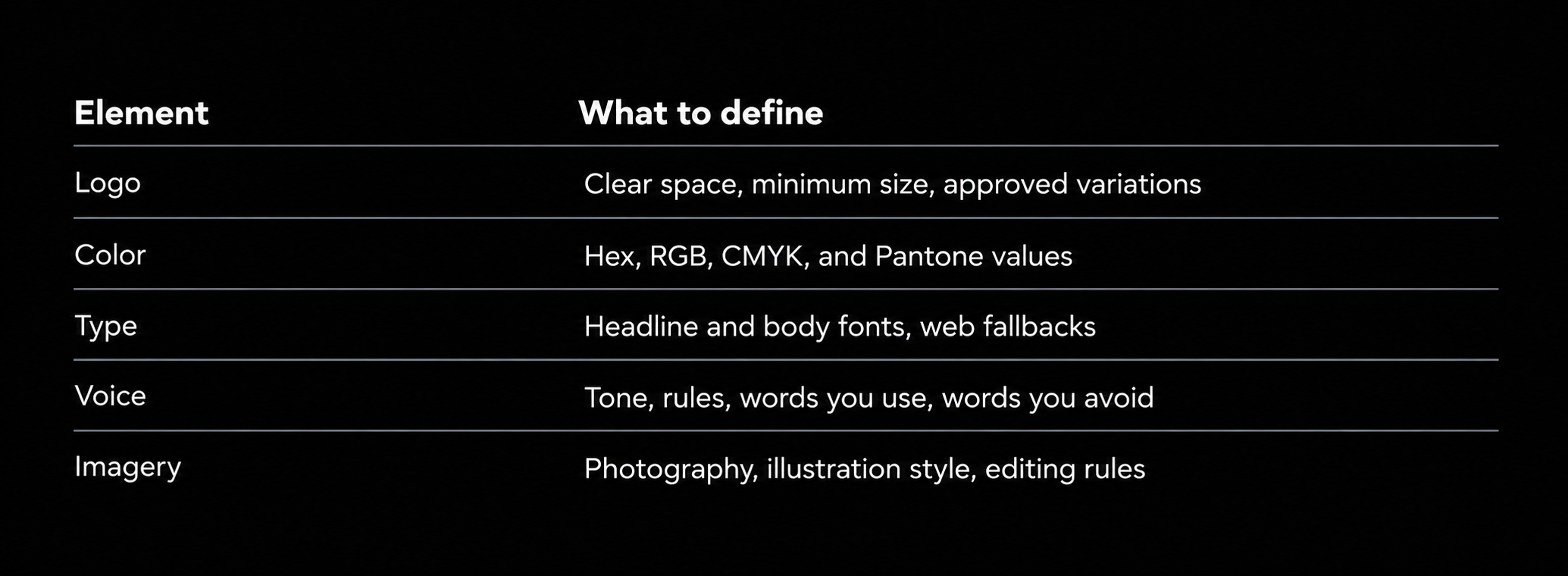
Then check your marketing materials against them. Blog posts and content marketing should sound like your emails. Social media marketing should look like your advertising campaigns, adjusted for each platform's format rather than reinvented for it.
Spotify runs this well: its Wrapped campaign uses the same bold type and color blocking on billboards, in-app screens, and Instagram Stories.
Set a review step before anything publishes. One reviewer catching a wrong shade of green is cheaper than a year of drifting design.
Support conversations are where your brand promise gets tested.
Give your team language guidelines, not scripts. If your voice is warm and plain, "We've refunded that for you — sorry for the trouble" fits better than "Your case has been escalated per policy."
Set standards for response time, refund handling, and how to say no. Casper's 100-night trial works as a brand signal because the return process is genuinely simple, not because the number sounds good.
Also connect service to the rest of the customer journey. Reps should know what campaign a customer saw, what the packaging said, and what the site promised at checkout. Mismatches between those messages create most complaints.
Employees deliver the brand experience every day, so they need to understand it.
Cover brand values, voice, and positioning during onboarding — not just the tools and the org chart. Keep brand assets somewhere easy to find, and name one person or small team as the owner.
Company culture and employer branding feed each other. Airbnb's "belong anywhere" idea shapes how it recruits and how hosts are supported, which is why the message holds up outside marketing.
A few practical moves:
When staff can explain what the brand stands for in a sentence, consistency stops depending on approvals.
A brand story explains where you came from, what you stand for, and why any of it matters to the person reading it. The strongest ones pair an honest origin story with clear values and a voice that fits the audience you actually want to reach.
Your origin story is the reason your company exists. It should answer three questions: what problem you noticed, what you did about it, and what you learned along the way.
Keep it accurate. Nantucket Nectars printed "with only a blender and a dream" on its bottles because two graduates really did start with a floating store off Nantucket.
Patagonia traces back to Yvon Chouinard selling climbing gear he made himself, which is why its environmental positions read as consistent rather than convenient.
Small details help more than big claims. Name the year, the place, the first customer, the first mistake.
If your beginning is ordinary, say so. An underdog story works because people see themselves in it, not because it sounds impressive.
Brand values only matter when they show up in your brand messaging and in what you sell.
Start by writing down three to five values in plain words. Then check each one against a simple test:
Question
Why it matters
Does this change a decision we make?
Values that cost nothing sound hollow
Can a customer see proof of it?
Proof builds trust faster than claims
Would a competitor say the opposite?
If not, it isn't a differentiator
Nike's messaging centers on effort and persistence, which is why its ads feature athletes at every level, not just champions.
Your brand voice carries these values into everyday copy. Decide whether you sound direct or warm, plain or playful, and then apply that to product pages, emails, and support replies.
Emotional connection comes from relevance, not volume. Learn what your target audience is dealing with, then speak to that directly.
Gen Z buyers tend to research claims before they believe them. Vague statements about sustainability or inclusion invite scrutiny, so publish specifics: sourcing details, pay policies, repair programs.
Coca-Cola's "Share a Coke" campaign worked because it handed the story to customers by putting their names on the bottle. People shared photos because the moment was theirs.
Try the same approach at a smaller scale:
A brand only holds its value when someone checks on it regularly. Brand management means auditing what exists today, tracking the numbers that show whether people know and trust you, and deciding when a change is worth the disruption.
A brand audit is a scheduled review of every place your brand shows up. Most teams run one once a year, or after a merger, a product launch, or a leadership change.
Start by gathering your assets in one place. Look at your website, social profiles, packaging, email templates, sales decks, and job listings.
Then compare each one against your brand guidelines. You're checking for brand consistency: the same logo files, the same color values, the same voice, the same core message.
Ask three questions as you go:
Finish with a fix list, ranked by how many people see the problem.
You can't manage brand equity without numbers. Pick a small set of metrics and check them on the same schedule every quarter.
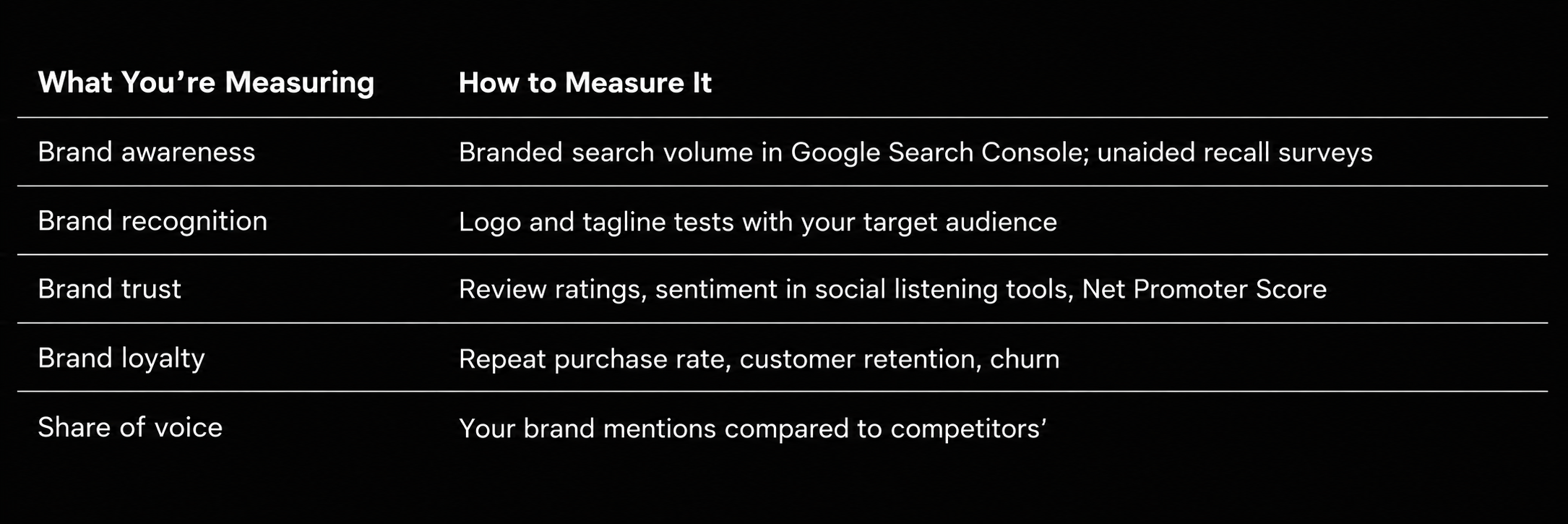
Branded search is one of the most useful early signals. When more people type your company name into Google instead of a generic product term, awareness is climbing.
Pair the hard numbers with direct feedback. Surveys and customer interviews tell you why the numbers moved, which dashboards rarely explain.
Tools like HubSpot, Brandwatch, or Google Analytics can collect much of this automatically. Set a baseline first, or you won't know what progress looks like.
Rebranding is expensive and it resets some of the recognition you've built. Do it for real reasons, not because the logo feels dated to your team.
Clear signals it's time:
Weak reasons include internal boredom, a new executive wanting a mark on the company, or one competitor's redesign.
You also have options short of a full rebrand. A brand refresh updates the visual identity while keeping the name, core colors, and equity you've already earned.
If you do rebrand, tell customers before the change goes live. Explain what's changing, what isn't, and why.
An AI writer can speed up first drafts, product descriptions, and social captions. It can also flatten your voice into something generic if you let it run unsupervised.
Feed the tool your actual brand guidelines. Give it voice rules, example sentences, banned phrases, and real customer language pulled from reviews and support tickets.
Then edit every draft. AI doesn't know your customer's specific frustration, your founder's story, or the detail that makes your product different.
Templates work the same way. Locked design templates in Canva, Figma, or Frontify keep colors and spacing consistent across teams, which protects recognition.
The line to hold: use automation for structure and speed, keep humans in charge of judgment, opinion, and anything a customer will read as a promise.