How to Design a Trade Show Booth That Stops People at RSA, AWS re:Invent, or Web Summit
One claim, one visual, one reason to stop: designing booth creative for busy tech events, plus the full event kit.
Creative
October 29, 2026
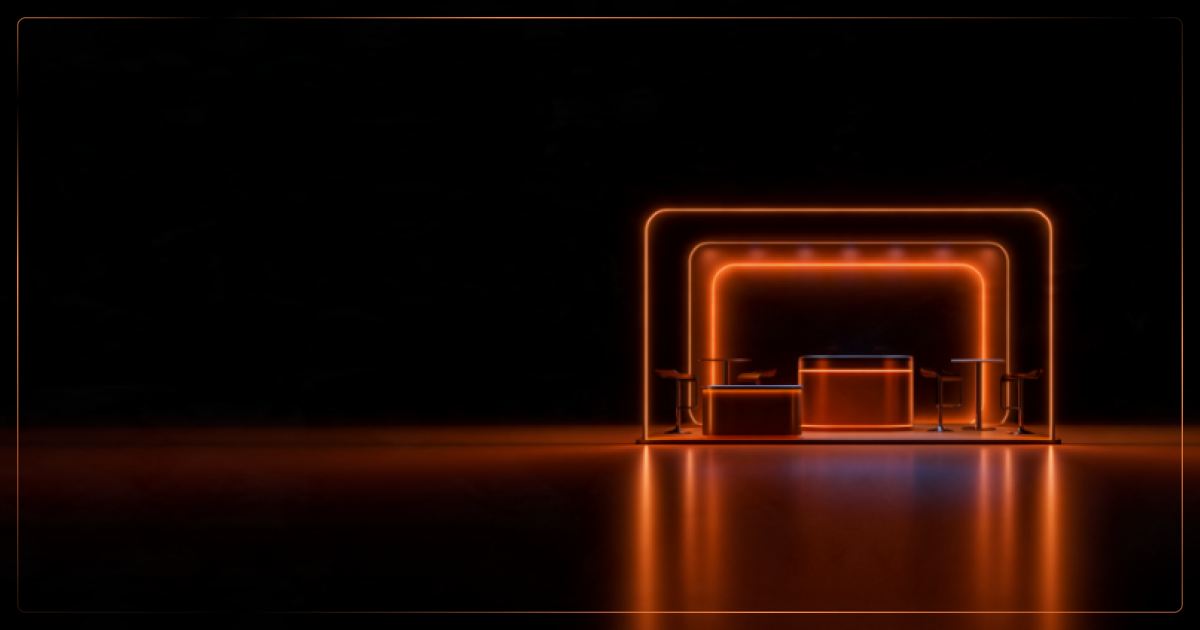
At a major tech event, your booth has about three seconds. That is roughly how long it takes an attendee to walk past, glance over, and decide whether you are worth slowing down for. At RSA, AWS re:Invent, or Web Summit, they are making that decision hundreds of times a day, in a hall full of companies that all claim to be AI-powered, secure, and scalable.
Most B2B tech booths lose that three-second test. Not because the budget was too small, but because the creative was designed like a website: too much text, too many messages, and a logo that tells passers-by nothing about why they should care.
This guide covers how to design a trade show booth that stops the right people, and the full event creative kit that turns a busy booth into pipeline.
Stand out by saying less. The booths that stop people at big tech events have a clear hierarchy that works at walking speed:
Everything else, including feature lists, integrations, and certifications, belongs at eye level inside the booth or on screens and handouts, where people who have already stopped can read it.
Think of the backdrop as a billboard, not a brochure. Work through it in three zones:
Your logo and the headline claim. This is what people see above the crowd, so it must work at a distance and without context.
The supporting visual and two or three short proof points: a recognizable customer, a key metric, or a category position. Keep it scannable.
Screens, demo stations, QR codes to specific landing pages, and details. This is where a technical buyer gets the depth they came for.
The principles stay the same, but the audience and context shift:
For smaller regional events and partner summits, the same hierarchy applies at a smaller scale, often with a pop-up banner and a table. One claim, one visual, one CTA still works.
The booth gets the attention, but the surrounding assets decide whether the event creates pipeline:
Our Event & Campaign Creative work covers the full kit, so the booth, the follow-up, and the sales materials all tell the same story.
Start eight to twelve weeks before a major show. Large-format printing, booth builder deadlines, and venue rules set hard cut-off dates, and late changes cost more. A practical timeline:
A trade show booth succeeds when a stranger walking past understands what you do and why it matters in three seconds. Lead with one clear claim, back it with one strong visual, give people a reason to step in, and make sure the creative around the booth is ready to turn those conversations into meetings.
Contact us to start a conversation.
Review our Marketing & Sales Collateral page.
As little as possible at the top and middle of the booth: a short headline and two or three proof points. Detailed information belongs on screens, handouts, and landing pages for visitors who have already stopped.
Most large-format printers ask for print-ready PDFs or vector files in CMYK, at full size or a specified scale, with bleed. Always confirm specifications with your booth builder before final design.
Yes, if it is designed for a trade show: short loops, no reliance on sound, large text, and a clear message in the first few seconds. A product demo loop on a large screen often attracts more attention than static graphics.
Track meetings booked, qualified conversations, and pipeline created from event leads, not just badge scans. Tie every QR code and landing page to the event so you can attribute results.